Monday, December 13, 2021

Final Blog

    So even though my semester of my first year seminar class in 2021 concludes, it doesn't mean that the blogging will. This class taught me so much, taught me things I have never heard about in the 18 years I've been on Earth. Blogging is not only enjoyable but also gives me the chance to express one of my First Amendment rights, Freedom of Speech. 

    Honestly, if MLK was still alive, he would have a post every other day that expanded on his ideal dream to change the way things were back then. I feel like it could have attracted a lot more attention but that would be if EVERYONE was on the internet and followed his blog. He would have told the world about the changes that needed to be made and whether or not he was planning another protest or march(to get the word out and attract more people to help). The only downside about the internet is that everyone of all races would have socials like this and some would be against it and eventually plan to attack King's protest and hurt not only him but potentially thousands of others. In addition to MLK, Malcolm X and many other Black influential leaders would have blogs and if anything create one big blog so all their powerful ideas and words are on one page. 


    The internet expands the horizon about getting word out about marches like Black Lives Matter just like the Civil Rights Movement and "The March". Also similar to the past, when there were marches and protests, it wasn't only Blacks that participated. People from different skin colors and backgrounds came out and supported both movements.

August 1963


June 2020


With the internet and social media starting to become a big form of communication within the politicians and Americans, one sentence can turn into a social media war. In my opinion, blogging can both hurt and help the constitutional law. Today's day and age, politicians are having a hard time making good decisions for the good of the people and the "United" states isn't looking so united right now. But I'm praying that mayors and governors etc. make the best decision for the people while keeping the Amendments in mind. In addition to politicians, we the people also have a say but our opinions will clash with other that could cause conflict.

    All history aside, blogging had its pros and cons. Pro, I get to express my freedom of speech, freedom of the press and much more. I also get to blog whatever topic I want whenever I want. The blogging doesn't have to stop once FYS is over. A con is that there are times where I'll have a blog to post but get a brain fart and forget everything I was going to say. Especially the really important details to make the post spicy. I enjoyed being able to research past historical cases and learn about all the people that made the US what it is today, good and bad. 
    
    Dear future students, I recommend not slacking off when it comes to blogs because honestly you could get caught up with one and get so into detail with it that you forget about all the others. Don't be like me and procrastinate but also be like me and have fun while you're at it. It's worth it, trust me :)

Sunday, December 12, 2021

Brown v Board

     In the case of Brown v Board, not only did it change history, but it also changed how schools were set up. If this is not already known, Brown v Board is a case where Linda Brown was denied admission to a public elementary school close to home and was told to go one further away. Oliver Brown, Linda's father, was furious about this. "Brown, an African Methodist Episcopal Church pastor and a Santa Fe Railway worker, wanted his daughter to be allowed to enroll in the all-white elementary school — not because the all-white school was superior to the all-black elementary school she attended two miles away — but because it was a matter of principle."

Linda Brown.

    As this case went on, the Brown family and their lawyers used "Separate but equal", the decision made in1896 of the case of Plessy v. Ferguson. They used the resources of this past case and also used it to argue that they created equal facilities, even though races were segregated. Plaintiffs in the case also claimed that the "separate but equal" ruling violated the equal protection clause of the 14th Amendment. One thing that was unknown is that according to Linda Brown, "Quality education was “not the issue at that time,”... “but it was the distance that I had to go to acquire that education.”

    In 1951, with the help of the NAACP which was led by attorney Charles S. Scott, a lawsuit was filed against the school district in federal court but unfortunately lost. The case was then appealed and taken to the Supreme Court a year later. The case combined five other cases from across the country that was involved with desegregation within schools. “The other cases included: Bolling v. Sharp, in D.C.; Briggs v. Elliot in South Carolina; Belton v. Gebhart (Bulah v. Gebhart) in Delaware; and Davis v. County School Board of Prince Edward County in Virginia."

    In addition to Brown being the lead plaintiff in the case, Thurgood Marshall could back him up as Marshall was the chief counsel for the NAACP Legal Defense and Education Fund and "led the arguments on behalf of black children denied access to all-white schools, challenging the “separate but equal” legal doctrine that had stood since 1896 with the Supreme Court ruling in Plessy v. Ferguson."

    On the 17th of May 1954, the Supreme Court ruled that separate educational facilities are inherently unequal. It was in the words of Chief Justice Earl Warren, "We conclude in the field of education, the doctrine 'separate but equal' has no place. Although Oliver and Linda Brown are deceased, their history will forever live on.


Above are students at Barnard Elementary School in Washington, D.C., one of the first schools to desegregate after the Brown ruling.

https://hechingerreport.org/opinion-six-decades-later-brown-v-board-education-ruling-is-still-only-an-aspiration/


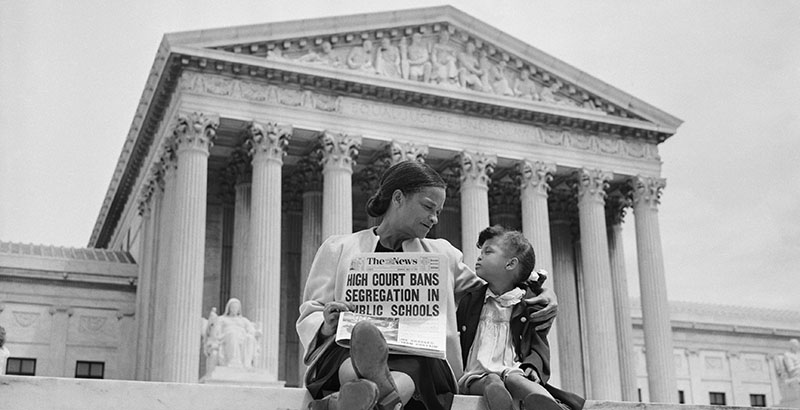
Nettie Hunt and her daughter Nickie sit on the steps of the U.S. Supreme Court following the high court's ruling in the Brown v. Board of Education case. (Getty Images)

https://www.the74million.org/article/mcclellan-on-the-anniversary-of-brown-v-board-celebrating-the-unsung-female-heroes-of-the-landmark-school-desegregation-ruling/


More Bibliography:

https://www.washingtonpost.com/news/retropolis/wp/2018/03/27/the-determined-black-dad-who-took-linda-brown-by-the-hand-and-stepped-into-history/

https://americanhistory.si.edu/brown/history/index.html


Thursday, December 9, 2021

EOTO Regents v Bakke

 Olympic protest of 1968

    As we know it, the Olympics are a series of sports where men and women from across the globe come to compete for the gold medal. But it wasn't always fun and games. In 1968, a San Jose State sociology professor, Harry Edwards, founded the Olympic Project for Human Rights, which included Tommie Smith and John Carlos as leaders. The project focused on the welfare of Black people globally and advocated for Black athletes. Specifically, they fought for the hiring of Black coaches and the barring of South Africa and (what is now) Zimbabwe from the Olympics for practicing apartheid. The African- American athletes intention was to draw the attention from all across the globe to address the problem, people of color in the U.S spotlighting the injustice and inequality millions of Black Americans encounter everyday.

    When receiving their medals, the duo stepped up to the podium wearing their symbolic beads, scarves, socks, and gloved fists. Carlos used a black shirt to cover the "USA" on his uniform to "reflect the shame I felt that my country was traveling at a snail's pace toward something that should be obvious to all people of good will," which he further explains in his book, The John Carlos Story: The Sports Moment That Changed the World. 

The John Carlos Story: The Sports Moment That Changed the World by [Dave Zirin, John Carlos, Cornel West]

    Wearing beads and scarves to oppose lynchings and black socks with no shoes to highlight poverty, African American sprinters Tommie Smith and John Carlos took to the podium during the October 16, 1968, Olympic medal ceremony in Mexico City to receive their respective gold and bronze medals in the 200-meter race. But it was a single accessory—a black glove—and an accompanying gesture—a raised fist during the American national anthem—that sparked an uproar. From that moment, the two athletes would be vilified, threatened and, in some circles, celebrated.

    During the award ceremony, Smith and Carlos, gold and bronze medalists, raised their fists in honor of Black power, and took off their shoes to symbolized Black poverty. In addition, the two men had such a powerful impact with their movement, that a statue was made of them.

A statue commemorating Tommie Smith and John Carlos' brave protest at the 1968 Olympics, a watershed moment for civil rights. Tommie Smith, Jesse Owens, Robert Kennedy, Martin Luther King, Us History, Black History, Statues, 1968 Olympics, Bronze

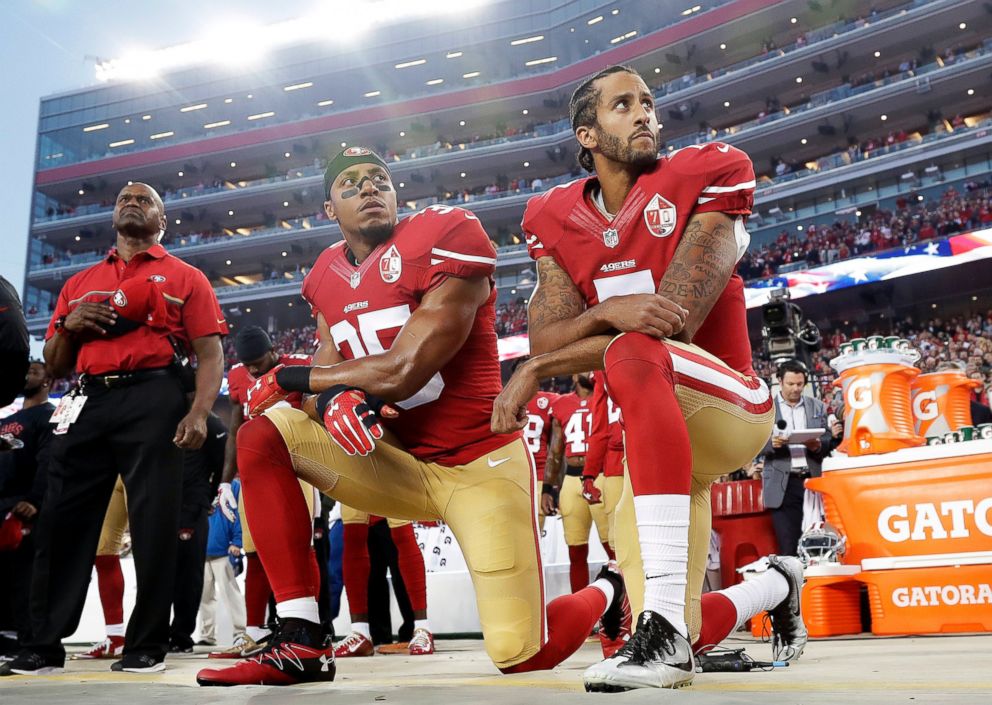
Colin Kaepernick decided to continue the movement but in a different way in 2016 during the national anthem at a NFL football game. 
PHOTO: San Francisco 49ers safety Eric Reid (35) and quarterback Colin Kaepernick (7) kneel during the national anthem before an NFL football game against the Los Angeles Rams, Sept. 12, 2016.
Bib:

(EOTO) Plessy v Ferguson

    After hearing the trial Plessy v Ferguson, I was informed of many things that have gone on the past when it comes to rights for black Americans. How no matter of skin color, everything is looked at through the eye of a white man. 


Once my peers finished this argument between both parties, I was given the information that was somewhat related to the case. I learned many things I never knew existed in the past, specifically the 1890s. I knew of the Great Depression that was one of the many lows in American history. But what I didn't know of what downfalls that had came before it. One of them being the Depression of 1893. "The Depression of 1893 was one of the worst in American history with the unemployment rate exceeding ten percent for half a decade." 

    The Depression of 1893 included strikes, crusades, change in the economy and much more. But to change to a positive note, there was much economic growth. "Railroads opened new areas to agriculture, linking these to rapidly changing national and international markets...Railroad construction was an important spur to economic growth. Expansion peaked between 1879 and 1883, when eight thousand miles a year, on average, were built including the Southern Pacific, Northern Pacific and Santa Fe...The post-Civil War generation saw an enormous growth of manufacturing. Industrial output rose by some 296 percent, reaching in 1890 a value of almost $9.4 billion. In that year the nation’s 350,000 industrial firms employed nearly 4,750,000 workers. Iron and steel paced the progress of manufacturing."
  
    
    There is much more information related to the economic highs and lows in the U.S but there is more to the topic that can co-inside to the main argument of Plessy v Ferguson, the fact that Greeks and Romans even had slaves. Although the religions are split into three , surprisingly, in the religion of Christianity, Jesus himself never spoke out about slavery. 

    In the Jim Crow era in 1896, while there was chaos, women fought for their rights. There was also financial depression aka The Panic of 1893. 


https://eh.net/encyclopedia/the-depression-of-1893/

Tuesday, November 9, 2021

(Mock Trial) Plessy v. Ferguson

    The case of Plessy v. Ferguson is one that became a landmark decision made by the Supreme Court in the late 1890s. Homer Plessy was an African American with fair skin. Plessy passed as a white man and lived in a white society because of his skin. This case was based on the fact that a mixed man was jailed for sitting in the whites-only section on a train when it was forbidden and refused to move to his correct place on the train.


     Recalled, in the past, white Americans had more privileges than black Americans. So in this case, when it came to being a passenger on a locomotive, whites were first class and blacks were second class. Plessy bought a first-class ticket from New Orleans, Louisiana to Covington, Louisiana. When he boarded the "whites only" railroad car and handed his ticket to the conductor, J.J. Dowling, Plessy had to tell the conductor that he was one-eighth black.

  Why? Keep in mind, Plessy was seven-eighths whiteHe was told to move to the colored car but refused to do soThe conductor took fury to this and called police. From there, Plessy was thrown off the train then was arrested and beaten by police. As Plessy was doing no harm, he was still jailed. Although Plessy used no force at all, the conductor AND police used violent and physical force. 

    Plessy then challenged the Jim Crow laws stating that it violated the Equal Protection Clause. The case went all the way up to the Supreme Court. It is to be said that Plessy was kicked off because of bad morals and that he should be treated as equal. This being said, this case goes against the 13th and 14th Amendments, which "abolished slavery “within the United States, or any place subject to their jurisdiction" and "guaranteed all citizens 'equal protection of the laws' ". In addition, Plessy was born in the states thus no matter skin color, should have the same rights. According to the legal arguments in Plessy's defense, this case was unconstitutional. To continue, the bible was used to back up this matter. In other words, the bible said " Masters should respect the slaves because they too are slaves to the lord." 

    Now, in Ferguson's (John Howard Ferguson) defense, he argued that black Americans were ungrateful and that they violated the law. Said in History. com, In declaring separate-but-equal facilities constitutional intrastate railroads, the Court ruled that the protections of the 14th Amendment applied only to political and civil rights (like voting and jury service), not "social rights" (sitting in the railroad car of your choice).

https://www.history.com/topics/black-history/plessy-v-ferguson

    In Fergusons legal argument, it is said that the state has the right to make laws for public safety. Also, Plessy tampered with the Separate Car Act. The argument was also more personal than legal. Therefore, the Court, 7-1, decided that its ruling goes to the state and not Plessy. In the words of Judge Henry Brown," If this be so, it is not by reason of anything found in the act, but solely because the colored race chooses to put that construction upon it."


Tuesday, November 2, 2021

(EOTO) Race Riots

                                   RACE RIOTS 

The definition of a race riot is a riot caused by racial dissensions or hatreds. Many of these riots took place in states big and small.  "Race riots broke out in most of the country’s large cities, notably in 1965 in the Watts district of Los Angeles, which left 34 dead, and two years later in Newark, New Jersey, and Detroit. Four summers of violence resulted in many deaths and property losses that left whole neighborhoods ruined and their residents more distressed than ever." 

In addition, Chicago had one of the worst race riots and took 38 lives. Going into depth about this particular riot of cause. In 1919, a riot was triggered when a black youth swam in Lake Michigan and drifted into area that was strictly reserved for whites. This very much upset the whites causing them to have rage therefore stoning him and sadly he drowned. 

According to many sources, Chicago was and unfortunately still is the state that has the most race riots. “Since the mid-1960s, the nature of race riots in Chicago (as elsewhere) has significantly shifted. Although violent black/white clashes continued into the mid-1970s, the term's use shifted during the 1960s to refer to the uprisings of poorer blacks (or Latinos) protesting ghetto conditions, especially police brutality…suggests that the issues surrounding racial violence are by no means a finished chapter in Chicago history.” 

Face-off between militia and veteran

Furthermore, in an article by after a final round provoked by the assassination of King in April 1968, the rioting abated. Yet the activist pursuit of political and economic empowerment for African Americans continued, reflected culturally in the Black Arts movement—which pursued populist art that promoted the ideas of Black separatism—and in the politicized soul music that replaced gospel and folk music as the sound track of the freedom struggle.

Race riots were an outcome of men and women of different races unnecessary a reason to take each other’s lives based off the difference of the color of their skin. What happened to life, liberty, and pursuit of happiness? Does it not exist anymore? The United States of America will never know.


Mapping Chicago’s 1919 race riots

White children outside the black family’s house they had set on fire during the Chicago race riot of 1919.


Bibliography:


https://www.britannica.com/topic/race-riot

http://www.encyclopedia.chicagohistory.org/pages/1032.html

https://news.uchicago.edu/story/mapping-chicagos-1919-race-riots

https://www.nytimes.com/2019/08/03/opinion/how-a-brutal-race-riot-shaped-modern-chicago.html


Friday, October 22, 2021

(Blog #5) A Woman I Look Up To: Cardi B

Cardi B

I look up to many women and one of them is Cardi B.

    Belcalis Marlenis Almánzar, known professionally as Cardi B, is an American rapper. Born and raised in New York City. She's known as the "stripper rapper" when in all actuality, she is just a human that came from nothing to something. In order to pay her bills and escape and an abusive relationship, Cardi did perform at strip clubs but that is not all she is known for. One of the reasons I love Cardi is because of her personality and her "don't let fame change you" mentality. 

    I can relate to her in so many ways. For one, we're both New Yorkers. Something I also love about Cardi is her personality. She chases the bag. As a role model to not just me but other women around the world, she has many thoughts and words that give off that energy of "I am that bitch".

    Two of my favorite quotes from Cardi are “I’m the rose that came from concrete.” and “Knock me down 9 times, but I get up 10.” Cardi was just someone that posted on Vine and Instagram. She was noticed and starred in Love and Hip Hop: New York. She used her talent and was noticed after she did a musical debut on Jamaican reggae singer Shaggy's remix to his single "Boom Boom", alongside fellow Jamaican dancehall singer Popcaan.  

    Almost the entire world knows, but they forget that Cardi is one of the two daughters of a Dominican father and Afro-Trinidadian mother, this meaning, she is bilingual in Spanish. It is clear to notice in the songs she collaborated with "La Modelo" and "Me Gusta".

    Cardi has a tough and frank attitude and I not only live for it but it's something that I admire about her. She keeps it real and doesn't sugarcoat things. She recently became a mother to two children and just knowing how Cardi shows off her attitude, she is a great mother, rapper, and wife.     


Final Blog

     So even though my semester of my first year seminar class in 2021 concludes, it doesn't mean that the blogging will. This class tau...