In the case of Brown v Board, not only did it change history, but it also changed how schools were set up. If this is not already known, Brown v Board is a case where Linda Brown was denied admission to a public elementary school close to home and was told to go one further away. Oliver Brown, Linda's father, was furious about this. "Brown, an African Methodist Episcopal Church pastor and a Santa Fe Railway worker, wanted his daughter to be allowed to enroll in the all-white elementary school — not because the all-white school was superior to the all-black elementary school she attended two miles away — but because it was a matter of principle."

As this case went on, the Brown family and their lawyers used "Separate but equal", the decision made in1896 of the case of Plessy v. Ferguson. They used the resources of this past case and also used it to argue that they created equal facilities, even though races were segregated. Plaintiffs in the case also claimed that the "separate but equal" ruling violated the equal protection clause of the 14th Amendment. One thing that was unknown is that according to Linda Brown, "Quality education was “not the issue at that time,”... “but it was the distance that I had to go to acquire that education.”
In 1951, with the help of the NAACP which was led by attorney Charles S. Scott, a lawsuit was filed against the school district in federal court but unfortunately lost. The case was then appealed and taken to the Supreme Court a year later. The case combined five other cases from across the country that was involved with desegregation within schools. “The other cases included: Bolling v. Sharp, in D.C.; Briggs v. Elliot in South Carolina; Belton v. Gebhart (Bulah v. Gebhart) in Delaware; and Davis v. County School Board of Prince Edward County in Virginia."
In addition to Brown being the lead plaintiff in the case, Thurgood Marshall could back him up as Marshall was the chief counsel for the NAACP Legal Defense and Education Fund and "led the arguments on behalf of black children denied access to all-white schools, challenging the “separate but equal” legal doctrine that had stood since 1896 with the Supreme Court ruling in Plessy v. Ferguson."
On the 17th of May 1954, the Supreme Court ruled that separate educational facilities are inherently unequal. It was in the words of Chief Justice Earl Warren, "We conclude in the field of education, the doctrine 'separate but equal' has no place. Although Oliver and Linda Brown are deceased, their history will forever live on.

Above are students at Barnard Elementary School in Washington, D.C., one of the first schools to desegregate after the Brown ruling.
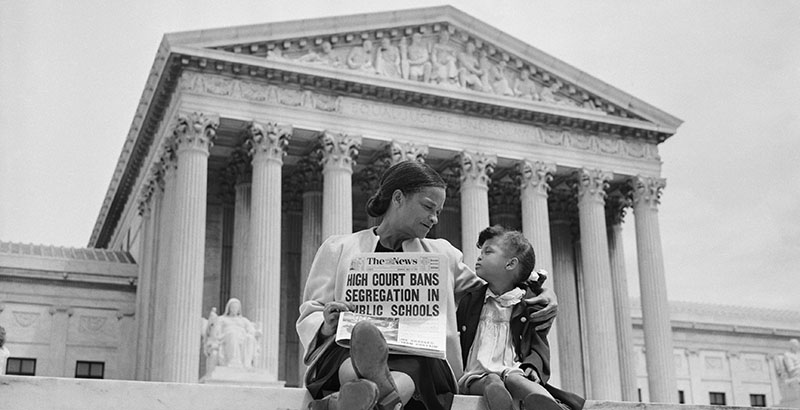
Nettie Hunt and her daughter Nickie sit on the steps of the U.S. Supreme Court following the high court's ruling in the Brown v. Board of Education case. (Getty Images)
More Bibliography:
https://americanhistory.si.edu/brown/history/index.html


No comments:
Post a Comment