Thursday, December 9, 2021

EOTO Regents v Bakke

 Olympic protest of 1968

    As we know it, the Olympics are a series of sports where men and women from across the globe come to compete for the gold medal. But it wasn't always fun and games. In 1968, a San Jose State sociology professor, Harry Edwards, founded the Olympic Project for Human Rights, which included Tommie Smith and John Carlos as leaders. The project focused on the welfare of Black people globally and advocated for Black athletes. Specifically, they fought for the hiring of Black coaches and the barring of South Africa and (what is now) Zimbabwe from the Olympics for practicing apartheid. The African- American athletes intention was to draw the attention from all across the globe to address the problem, people of color in the U.S spotlighting the injustice and inequality millions of Black Americans encounter everyday.

    When receiving their medals, the duo stepped up to the podium wearing their symbolic beads, scarves, socks, and gloved fists. Carlos used a black shirt to cover the "USA" on his uniform to "reflect the shame I felt that my country was traveling at a snail's pace toward something that should be obvious to all people of good will," which he further explains in his book, The John Carlos Story: The Sports Moment That Changed the World. 

The John Carlos Story: The Sports Moment That Changed the World by [Dave Zirin, John Carlos, Cornel West]

    Wearing beads and scarves to oppose lynchings and black socks with no shoes to highlight poverty, African American sprinters Tommie Smith and John Carlos took to the podium during the October 16, 1968, Olympic medal ceremony in Mexico City to receive their respective gold and bronze medals in the 200-meter race. But it was a single accessory—a black glove—and an accompanying gesture—a raised fist during the American national anthem—that sparked an uproar. From that moment, the two athletes would be vilified, threatened and, in some circles, celebrated.

    During the award ceremony, Smith and Carlos, gold and bronze medalists, raised their fists in honor of Black power, and took off their shoes to symbolized Black poverty. In addition, the two men had such a powerful impact with their movement, that a statue was made of them.

A statue commemorating Tommie Smith and John Carlos' brave protest at the 1968 Olympics, a watershed moment for civil rights. Tommie Smith, Jesse Owens, Robert Kennedy, Martin Luther King, Us History, Black History, Statues, 1968 Olympics, Bronze

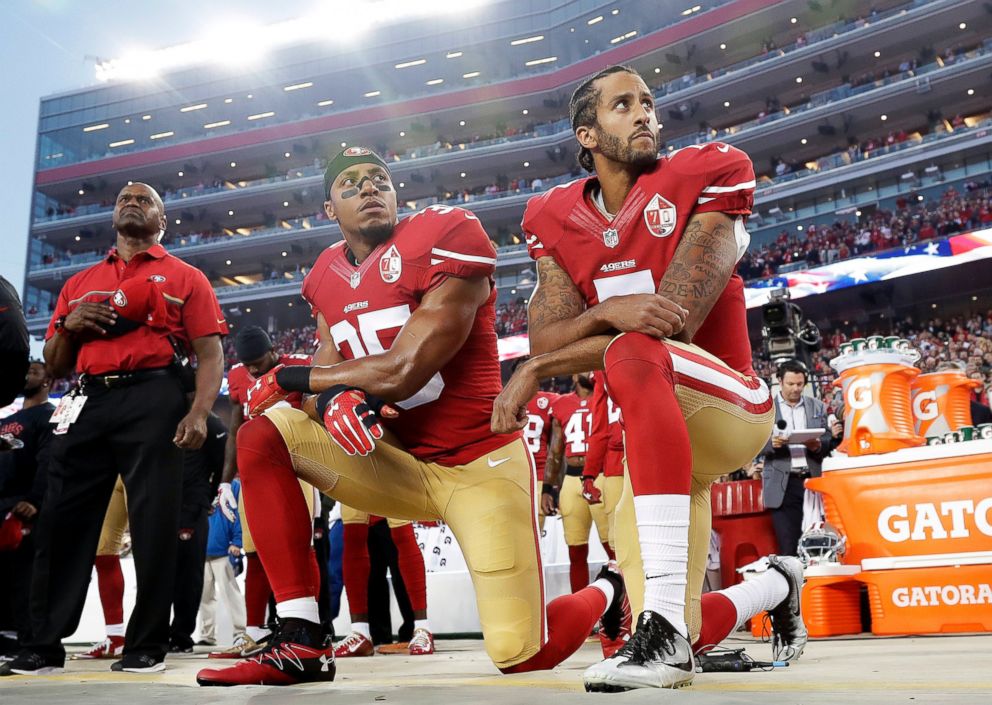
Colin Kaepernick decided to continue the movement but in a different way in 2016 during the national anthem at a NFL football game. 
PHOTO: San Francisco 49ers safety Eric Reid (35) and quarterback Colin Kaepernick (7) kneel during the national anthem before an NFL football game against the Los Angeles Rams, Sept. 12, 2016.
Bib:
Black Power

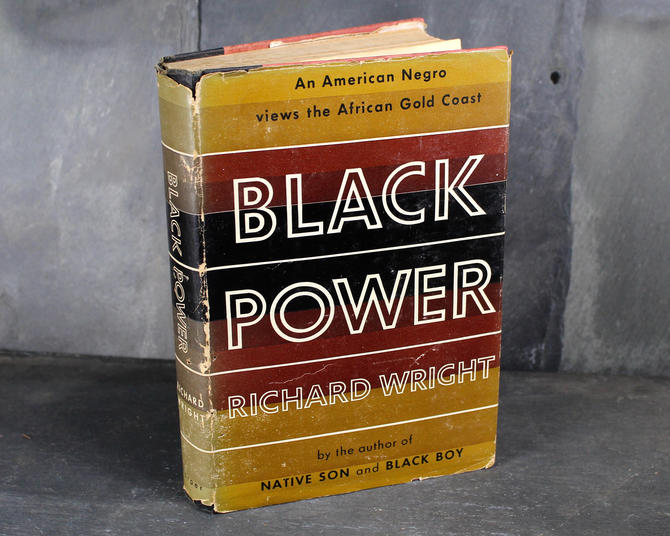
The mid 1960s-1970s is when Black power began as a movement that was and still is revolutionary. This emphasizes racial pride, economic empowerment and created cultural institutions. During this time period, there was a high demand for courses related to Black history. If we look further into the term "Black power", it has various origins. The roots can be traced back to author Richard Wright's non-fiction work Black Power which was published in 1954. 

1954 FIRST EDITION Black Power by Richard Wright, Author of Native Son and Black Boy | FREE Shipping by Trovetorium


    Many African American men and women believe protesting segregation failed to address the poverty and powerlessness that generations of systemic discrimination and racism had been put upon many Black Americans. 
With the principles of racial ride, self-determination and much more expressed by the late Malcolm X along with liberation movements in Africa, Asia and Latin America, the movement expanded greatly and flourished.
     In the late 1960s and 70s, many argued that Black Americans should focus on creating economic, social and political power of their own, instead of trying to pursue being integrated into the white dominated society. 

Bib:

Black Is Beautiful


    On 28 January 1962, a large crowd formed outside Purple Manor, a nightclub in the Harlem neighbourhood of New York City. A fashion show was taking place – an event that proved so popular it had to be held for a second time that same night – which sparked a movement that would change the way black people were represented forever.
Kwame Brathwaite

    The show was called “Naturally ’62” and was organised by the African Jazz-Art Society & Studios aka (AJASS), a group of creatives, including photographer Kwame Brathwaite and his brother Elombe Brath. The show  featured black women who had chose to move from Western beauty standards
A self-portrait of Kwame Brathwaite, 1964, who was at the vanguard of the Black is Beautiful movement (Credit: Courtesy of the artist and Philip Martin Gallery, LA)

    Models who walked down the catwalk that night wore their afro hair with pride. Their clothes were inspired by many designers including Lagos, Accra and Nairobi. These women has beautiful darker skin and their bodies fuller-figured than the women pictured in fashion magazines, including black publications.

Naturally ’68 photo shoot, featuring Grandassa Models and founding members of AJASS.
Untitled (Fashion show at Renaissance Casino and Ballroom), 1967.

        The phrase “black is beautiful” referred to a broad embrace of black culture and identity. It called for an appreciation of the black past as a worthy legacy, and it inspired cultural pride in contemporary black achievements. In its philosophy, “Black is beautiful” focused also on emotional and psychological well-being. The movement affirmed natural hairstyles like the “Afro” and the variety of skin colors, hair textures, and physical characteristics found in the African American community. To present day, Black women have embraced their natural hair, and it will continue to grow from generation to generationUntitled (Black is Beautiful Poster from 1971), 1971.

Bib:


No comments:

Post a Comment

Final Blog

     So even though my semester of my first year seminar class in 2021 concludes, it doesn't mean that the blogging will. This class tau...